Nearshore vs Offshore: How US Companies Should Choose
Time-zone overlap by country, English levels, cost, the roles each model suits and five questions that settle it, from a recruiter that hires in both.
Nearshore
Latin America
- Same or nearly the same working day as the US
- Spanish, and Portuguese in Brazil
- Live calls, meetings and same-day replies
Offshore
North Africa, Eastern Europe, Philippines
- Bigger time difference, or work on your shift
- French, Arabic or English-first markets
- Overnight, extended and European-hours coverage
What's the difference between nearshore and offshore? Nearshore means hiring in a country close to your own time zone. For US companies that's mainly Mexico and Central and South America. Offshore means hiring further away, such as North Africa, Eastern Europe or the Philippines, usually with a bigger time difference. Choose nearshore when the role has to be live with your team or customers during your business day. Choose offshore when you need overnight or extended coverage, a language such as French or Arabic, or when your hire will work your shift anyway. Within a role, pay differences between regions are small next to the gap with a US hire, so hours and language usually decide.
Last updated: October 18, 2026 · By the Talentige recruitment team · Based on 1,750+ international hires since 2015
Onshore, nearshore, offshore: the three options
- Onshore
Hiring in your own country. Same hours and laws, highest cost.
- Nearshore
A nearby country in a similar time zone. For the US: Mexico, Colombia, Argentina, Brazil and the rest of Latin America.
- Offshore
A distant country with a bigger time difference. For the US: Morocco, Egypt, Eastern Europe, the Philippines and beyond.
The labels are relative. Morocco is offshore for a company in Texas but close to nearshore for one in London or Paris: since September 20, 2026 Morocco runs on GMT all year, the same clock as the UK in winter. That's why a Canadian or European business might weigh these options differently from a US one.
Nearshore vs offshore at a glance
| Nearshore (Latin America) | Offshore (North Africa, Eastern Europe, Philippines) | |
|---|---|---|
| Time vs US Eastern | 2 hours behind to 2 hours ahead | 4 to 13 hours ahead |
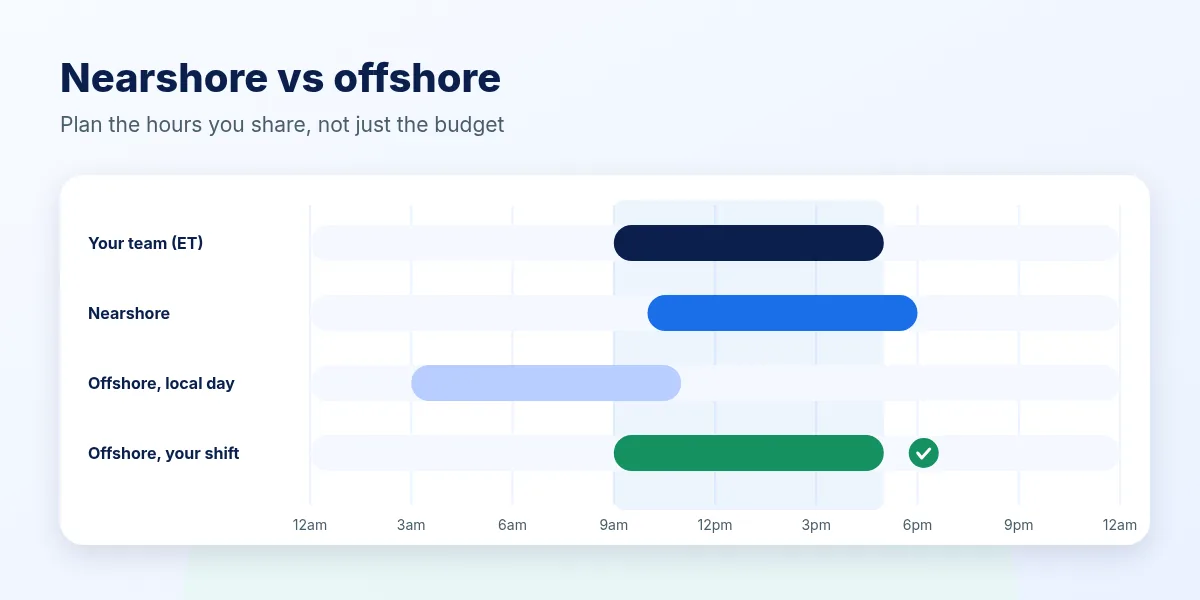
| Live overlap with a 9–5 Eastern day | 6–8 hours | 0–4 hours on their local day, or a full day if they work your shift |
| Languages | Spanish; Portuguese in Brazil; English | French and Arabic (Morocco), Arabic (Egypt), Polish and other European languages, English-first (Philippines) |
| Best for | Roles that are live all day: sales calls, meetings, scheduling, same-day replies | Overnight and weekend cover, European customers, French or Arabic work, async work |
| Watch out for | National English levels vary widely, so test every candidate | Clock changes, and planning handoffs if hours don't overlap |
| Talentige hires | 500+ across Latin America | 500+ in Morocco, 250+ in Egypt, 500+ in the Philippines; we also source in Tunisia, Algeria and Eastern Europe |
Overlap figures are for a standard 9:00–17:00 local day, computed from the IANA time zone database (see the next section).
Time-zone overlap: the factor that decides most hires
Overlap is the number of hours when your team and your hire are both in a normal working day. It decides how many live conversations you can have, how quickly questions get answered and whether a customer reaches a person or a voicemail. Here's how a standard 9:00–17:00 local day in each country lines up with a 9:00–17:00 day in New York:
Swipe to see the full chart, or open the table below.
See this chart as a table
| Country (city) | UTC offset (Jan / Jul) | Local time at 9:00 New York (Jan / Jul) | Overlap with 9–5 Eastern (Jan / Jul) | Overlap with 9–5 Pacific (Jan / Jul) |
|---|---|---|---|---|
| Mexico (Mexico City) | UTC−6 / UTC−6 | 08:00 / 07:00 | 7h / 6h | 6h / 7h |
| Colombia (Bogotá) | UTC−5 / UTC−5 | 09:00 / 08:00 | 8h / 7h | 5h / 6h |
| Argentina (Buenos Aires) | UTC−3 / UTC−3 | 11:00 / 10:00 | 6h / 7h | 3h / 4h |
| Brazil (São Paulo) | UTC−3 / UTC−3 | 11:00 / 10:00 | 6h / 7h | 3h / 4h |
| Morocco (Casablanca) | UTC+0 / UTC+0 | 14:00 / 13:00 | 3h / 4h | 0h / 1h |
| Poland (Warsaw) | UTC+1 / UTC+2 | 15:00 / 15:00 | 2h / 2h | 0h / 0h |
| Egypt (Cairo) | UTC+2 / UTC+3 | 16:00 / 16:00 | 1h / 1h | 0h / 0h |
| Philippines (Manila) | UTC+8 / UTC+8 | 22:00 / 21:00 | 0h / 0h | 0h / 0h |
Two things stand out. First, Latin America shares most of the US day all year. Mexico City is an hour behind New York in winter and two hours behind in summer, because most of Mexico stopped changing its clocks in 2022 while the US still does. Second, a local day in the Philippines doesn't overlap a US Eastern day at all, which is exactly why it suits overnight coverage, and why Talentige hires there work your shift when you need daytime cover.
Clock changes that move your overlap
Overlap isn't fixed. The US moves its clocks on the second Sunday in March and the first Sunday in November. Several hiring countries don't change at all, and the ones that do change on different dates:
Swipe to see the full chart, or open the table below.
See this chart as a table
| Country | Clock changes in 2027 |
|---|---|
| United States | Mar 14, Nov 7 |
| Poland (EU) | Mar 28, Oct 31 |
| Egypt | Apr 30, Oct 28 |
| Morocco | None |
| Mexico (most) | None |
| Colombia, Argentina, Brazil, Philippines | None |
- Mexico (most of the country) stopped observing daylight saving time on October 30, 2022. Border areas still follow the US schedule.
- Morocco moved to GMT (UTC+0) permanently on September 20, 2026, ending its seasonal and Ramadan clock changes.
- Egypt reintroduced daylight saving time in 2023: UTC+3 from the last Friday in April to the last Thursday in October, UTC+2 the rest of the year.
- Poland follows the EU's summer time, which starts and ends on different weekends from the US. For a few weeks each year the gap with New York is an hour shorter.
- Colombia, Argentina, Brazil and the Philippines have no clock changes in the IANA data for 2026–2027.
Write working hours in both time zones in your hire's contract, and put the US clock-change dates in your calendar. Our guide to international contractor agreements covers how to write hours and availability.
Three ways to plan around time zones
Pattern 1
Same hoursYour hire works their normal daytime, which already matches yours. The simplest setup, and the natural choice in Latin America.
Pattern 2
Your shiftYour hire works your hours from anywhere. Talentige hires work your shifts, so overlap becomes a question of how natural the hours are for the person, not whether they're possible.
Pattern 3
Follow the sunTwo or more hires in different regions each work their own daytime, so together they cover more of the clock. Common for support and dispatch.
Swipe to see the full chart, or open the table below.
See this chart as a table
| Region | Local 9:00–17:00 in US Eastern time (mid-January 2027) |
|---|---|
| Latin America (Bogotá) | 9am to 5pm |
| Morocco | 4am to 12pm |
| Philippines | 8pm to 4am |
Overlap planning checklist
- List the hours that must be live: customer calls, team meetings, dispatch windows.
- Choose the pattern: same hours, your shift or follow the sun.
- Write the hours in both time zones in the contract.
- Book recurring meetings inside the overlap, not at its edges.
- Agree a written end-of-day handoff for anything that runs across time zones.
- Add the US and the hire's country's clock-change dates to the team calendar.
English and language fit
National averages are a starting point, not a hiring decision. The EF English Proficiency Index (EF EPI) 2025 ranks 123 countries and regions using test results from 2.2 million adults. It also publishes scores by the job function test-takers report, and the difference between the two can be large:
Swipe to see the full chart, or open the table below.
See this chart as a table
| Country | Global rank (of 123) | Overall score | Customer service test-takers |
|---|---|---|---|
| Poland | 15 | 600 | 630 |
| Argentina | 26 | 575 | 617 |
| Philippines | 28 | 569 | 579 |
| Morocco | 68 | 492 | 502 |
| Brazil | 75 | 482 | 538 |
| Colombia | 76 | 480 | 570 |
| Egypt | 89 | 458 | 483 |
| Mexico | 103 | 440 | 599 |
| Global average | – | 488 | – |
Mexico is the clearest example: its overall score is below the global average, but test-takers working in customer service scored 599. The talent pool for English-speaking roles is very different from the national average. That's why every candidate should be tested individually. For customer-facing roles, our hiring guide suggests aiming for CEFR B2 or above.
Second languages often decide the country on their own:
- Spanish: Mexico, Colombia, Argentina and the rest of Spanish-speaking Latin America. See bilingual customer support.
- Portuguese: Brazil.
- French: Morocco, including French-English support.
- Arabic: Egypt and Morocco.
- English-first: the Philippines.
Cost: what changes and what doesn't
Nearshore is often assumed to cost more than offshore. In practice, within a role, the pay differences between our regions are small next to the gap with a US hire. Typical full-time monthly pay through Talentige:
| Role | Typical monthly pay (USD) |
|---|---|
| Sales representatives | $1,200–$1,700 |
| Admins and assistants | $1,200–$1,600 |
| Managers | $1,500–$2,300 |
| Developers | $1,400–$2,900 |
| Video editors | $1,000–$1,300 |
The costs that do differ between nearshore and offshore are less visible: meetings at awkward hours, slower answers when nobody overlaps and the time it takes to write good handoffs. A hire who works your shift removes most of those. To compare a hire with the same role in the US, use the overseas hiring cost calculator.
Talentige has two pricing options: One-time placement, a one-time fee based on annual salary, paid only when you hire, with a 90-day free replacement; or Month-to-Month, from $2,000/mo all-inclusive, with international payroll and contracts handled and free replacement throughout. Details are on our pricing page.
Which roles suit nearshore, and which suit offshore
Ask one question per role: does this person need to be live while your customers or team are working?
| Role | Live during your day? | Nearshore fit | Offshore fit |
|---|---|---|---|
| SDRs and appointment setters | Yes: calls in your prospects' hours | Strong e.g. SDRs in Mexico | Good on your shift |
| Customer support | Yes, often beyond 9–5 | Strong for daytime and Spanish | Strong for nights, weekends, French or Arabic |
| Dispatchers | Yes, including nights and weekends | Good for daytime | Strong e.g. dispatchers in the Philippines |
| Executive assistants | Yes: calendars and inboxes move all day | Strong e.g. assistants in Colombia | Good on your shift |
| Bookkeepers | Mostly not: work is deadline-based | Strong | Strong |
| Developers | Partly: stand-ups and code review | Strong in Latin America | Good in Eastern Europe (we don't recruit developers or IT in the Philippines) |
| Video editors | Rarely: work is delivered | Strong | Strong |
Hiring by industry? See how this plays out for HVAC and home services, trucking and logistics and real estate.
Decide in five questions
Does the role need to be live with customers or your team for most of your day?
Yes: nearshore, or an offshore hire on your shift. No: either works; keep going.
Do you need nights, weekends or 24/7 coverage?
Yes: offshore. The Philippines' daytime covers US nights, or combine regions to follow the sun.
Do you need a second language?
Spanish or Portuguese: Latin America. French: Morocco. Arabic: Egypt or Morocco.
Do you also serve Canada, the UK or Europe?
Yes: North Africa and Eastern Europe overlap European business hours and US mornings.
Is it a developer or IT role?
Yes: Latin America for US hours, or Eastern Europe. We don't recruit developers or IT in the Philippines.
Not sure which region fits your role?
Tell us the role, hours and languages on a free call and we'll recommend the country, then show you vetted finalists.
Book a free hiring call →Region snapshots
Nearshore
Latin America
Mexico City UTC−6 (no clock change) · Bogotá UTC−5 · Buenos Aires and São Paulo UTC−3
Spanish, Portuguese in Brazil, English. 500+ Talentige hires. The default for roles that are live through the US day.
Latin America · Mexico · Colombia · Argentina · Brazil
Offshore
Morocco
UTC+0 all year since September 20, 2026
French, Arabic, English. 500+ Talentige hires. A natural fit for Canada, Europe and French-language work, and its afternoons overlap US mornings.
Offshore
Egypt
UTC+2, UTC+3 from late April to late October
Arabic, English. 250+ Talentige hires. Suits Arabic-speaking markets and Europe.
Offshore
Philippines
UTC+8, no clock change
English, Filipino. 500+ Talentige hires. English-first, and its daytime covers US nights. We don't recruit developers or IT here.
Offshore
Eastern Europe
Warsaw UTC+1, UTC+2 in EU summer time
Polish and other European languages, English. A strong option for developers and for teams that also serve Europe.
Four mistakes to avoid
Hours and language decide whether a hire works. The pay gap between regions is small.
Your overlap can shrink or grow by an hour twice a year.
Test every candidate's English. The talent pool can differ sharply from the country score.
If hours don't overlap fully, a written end-of-day handoff keeps work moving.
Ready to compare candidates? Start with hiring overseas employees or the step-by-step guide to hiring international employees.
Nearshore, offshore or both: get vetted finalists in about 14 days
We recruit across Latin America, North Africa, Eastern Europe and the Philippines, so we'll recommend the region that fits your hours and languages, not the one we happen to cover.
Book a free hiring call →Pay nothing until you hire · 3–5 vetted finalists · 90-day replacement guarantee
Frequently asked questions
What is the difference between nearshore and offshore?
Which countries are nearshore for US companies?
Is nearshore more expensive than offshore?
How many hours of overlap do I need with a remote hire?
Can an offshore hire work US business hours?
Which countries have the best English for remote hiring?
What time zone is Morocco in now?
What is follow-the-sun coverage?
Sources
- IANA Time Zone Database, release 2026c (released July 8, 2026): UTC offsets and clock changes used for every overlap figure; release notes confirm Morocco's move to permanent UTC+0 on September 20, 2026. iana.org
- timeanddate.com, "Morocco Announces DST Will Be Abolished After Summer" (Decree No. 2.26.530, June 25, 2026), and Casablanca time zone page. timeanddate.com
- timeanddate.com, "Mexico Abolishes DST" (October 30, 2022; border areas and US DST schedule). timeanddate.com
- timeanddate.com, "Egypt Reintroduces DST to Save Energy" (2023; last Friday of April to last Thursday of October). timeanddate.com
- timeanddate.com, São Paulo time zone page (no clock changes 2020–2029). timeanddate.com
- EF Education First, EF English Proficiency Index 2025: global ranking (123 countries and regions, 2.2 million adults) and country pages with overall and job-function scores. ef.com
- Talentige placement data (as of October 2026): 1,750+ hires since 2015, including 500+ in Morocco, 250+ in Egypt, 500+ in the Philippines and 500+ across Latin America; typical monthly pay ranges by role; pricing options as published on talentige.com/pricing.