How to Hire International Employees: A Step-by-Step Guide
Eight steps from defining the role to a hire who's working only for you, based on 1,750+ international placements since 2015.
How do you hire an international employee? Define the role and hours, choose a country whose time zone, language and pay range fit, and pick a hiring model: freelancer, employer of record, agency or recruitment partner. Then budget the full cost, screen candidates with real skills tests, sign a locally compliant contract and collect the right US tax form, and onboard with a clear first-week plan. With Talentige you see 3–5 vetted finalists in about 14 days, and you pay nothing until you hire.
We've made 1,750+ international hires since 2015. This guide is what we've learned, step by step.
Last updated: October 12, 2026 · By the Talentige recruitment team
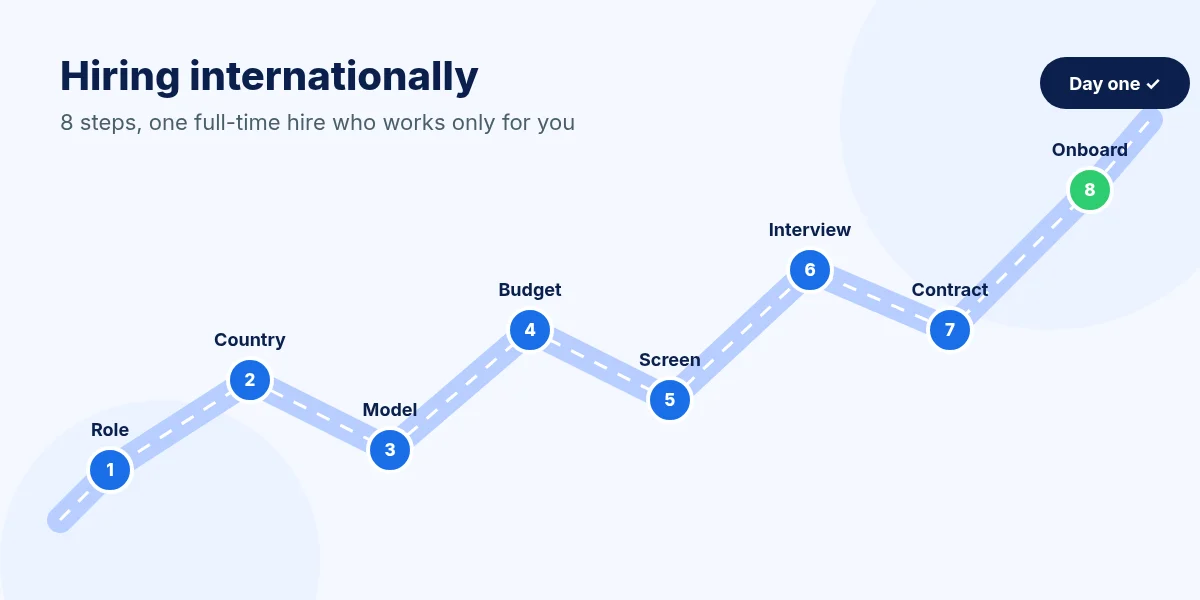
The eight-step roadmap
Most failed international hires go wrong at step one or step three, not at the interview. Take the steps in order and the rest gets easy.
- Define the roleOutcomes, hours, tools and language before anything else.
- Choose the countryTime zone, language and the pay range for the role.
- Pick a hiring modelFreelancer, EOR, agency or recruitment partner.
- Budget the full costPay, one-time fees and tools, compared with a US hire.
- Source and screenReal skills tests, English checks and background checks.
- Interview and chooseStructured interviews with 3–5 finalists.
- Sign a compliant contractLocally compliant contract, NDA, IP and US tax forms.
- Onboard, pay and keep themFirst-week plan, payment in your currency, guarantee.
Define the role before you look at countries
Start with outcomes, not a job title. "Executive assistant" can mean inbox and calendar, or it can mean running a CEO's projects. "Customer support" can mean email tickets, or inbound phone calls during a storm. Write down what the person will own in their first 90 days and how you'll know they're doing it well.
Then pin down the four constraints that decide everything else:
Turn this into a one-page scorecard: five to seven must-haves, a few nice-to-haves, and the tests you'll use to check each one. You'll reuse it at every later step, from the job post to the final interview.
A rule of thumb from our placements: if the role needs someone on your phones or in your systems every day, hire full-time. Part-time and project work suits marketplaces. Full-time, ongoing work is where an international hire pays back fastest.
Choose the country (time zone, language, pay)
The best country is the one where the role's hours feel like a normal day and the language is native. Cost matters, but the pay gaps between our main regions are small next to the gap with a US hire.
Latin America overlaps US business hours almost exactly and brings native Spanish (and Portuguese in Brazil). Morocco is a natural fit for Canadian and European companies and for French-language work, and its afternoons overlap US mornings. Egypt suits Arabic-speaking markets and Europe. The Philippines is English-first and its daytime covers US nights, which makes overnight support easy to staff.
Here's what Talentige placements typically pay in each region for two common roles:
| Region | Languages | Support rep pay (USD/month) | Admin / VA pay (USD/month) | Talentige hires | Strong fit |
|---|---|---|---|---|---|
| Latin America | Spanish, Portuguese (Brazil), English | $900–$1,500 | $1,000–$1,800 | 500+ | US hours overlap; Spanish-speaking customers |
| Morocco | French, Arabic, English | $1,000–$1,300 | $1,000–$1,300 | 500+ | Canada and Europe; French-language work |
| Egypt | Arabic, English | $800–$1,000 | $900–$1,100 | 250+ | Middle East and Europe; Arabic-language work |
| Philippines | English, Filipino | $1,000–$1,300 | $1,000–$1,300 | 500+ | US overnight coverage; English-first support (not dev/IT) |
Typical full-time monthly pay from Talentige placements, before our one-time placement fee. We also source in Tunisia, Algeria and Eastern Europe. We don't recruit developers or IT roles in the Philippines.
For a single country, start with our pages on Mexico, Colombia, Argentina, Brazil, Morocco, Egypt and the Philippines, or the regional guides for Latin America and North Africa.
Pick a hiring model
There are four common ways to hire someone in another country, plus a fifth (setting up your own local company) that rarely makes sense for fewer than a dozen people in one country.
| Item | Freelance marketplace | Employer of record (EOR) | Staffing agency / BPO | Recruitment partner (Talentige) |
|---|---|---|---|---|
| Who finds the person | You | You | The vendor | We do, then you choose |
| Who they work for | Often several clients | You (employed by the EOR) | Often shared across accounts | Only you, full-time |
| Ongoing fees | Platform fees | Monthly EOR fee | Ongoing markup or hourly rate | One-time fixed placement fee; a small retainer only if we also handle payment and management |
| Contract | Platform terms | Local employment contract | Vendor contract | Government-stamped, locally compliant contract + NDA |
| Best when | Short projects | You need formal local employment | You want a managed service | You want your own full-time hire |
Each model fits a different job. A freelance marketplace is fine for a logo or a two-week project. An employer of record (EOR) suits companies that need the person formally employed in their country with local benefits, and it doesn't find the person for you. A staffing agency or BPO gives you a managed seat, usually shared across clients. A recruitment partner finds, vets and contracts a full-time person who works only for you. Our EOR vs staffing agency vs Upwork guide compares the published fees side by side, and we also recruit for companies that already use an EOR.
A note on classification. In the US, the IRS decides whether someone is an employee or an independent contractor by looking at behavioral control, financial control and the relationship between the parties. In the worker's country, local law applies. Whatever model you choose, the contract has to be valid where the person lives. That's why every Talentige placement is on a government-stamped, locally compliant contract.
Budget the full cost
The full monthly cost of an international hire is their pay, plus any ongoing platform, EOR or agency fees, plus tools and equipment. With Talentige you pay the hire's monthly pay and a one-time fixed placement fee that depends on the role, and nothing until you hire. There's no monthly markup or retainer unless you want us to handle payment and management every month, which carries a small retainer.
See this chart as a table
| Role | Typical overseas pay (USD/month) | US cost with overhead (USD/month) |
|---|---|---|
| Virtual / admin assistant | $900–$1,800 | About $5,700 |
| Customer support | $800–$1,500 | About $5,300 |
| Bookkeeper | $1,000–$1,600 | About $6,000 |
| Executive assistant | $1,000–$1,800 | About $9,100 |
Why multiply by 1.43? US private employers spent $46.89 an hour on total compensation in June 2026, against $32.82 in wages and salaries. Benefits and payroll costs add about 43% on top of pay. Your overseas hire's pay is the cost, with no US benefits or payroll taxes on top.
Two budgeting tips. First, budget for the top of the range if the role needs a second language or specialist software. Second, decide on pay before you interview, so you don't lose your favorite finalist to a negotiation. Run the numbers for your roles and team size in the overseas hiring cost calculator.
Source and screen candidates
Write the job post from your scorecard: what they'll own, the hours in their local time, the tools, the pay range and the language requirement. Clear hours and pay filter out most mismatches before you read a single CV.
Then screen in layers, cheapest first:
- CV and written answers. Ask two short written questions in the application. They test written English and attention to detail at the same time.
- English level. For customer-facing roles, aim for CEFR B2 or above: the level at which someone can talk with native speakers fluently and spontaneously without strain on either side. For writing-heavy or executive roles, look for C1.
- Skills test on real work. A mock support ticket, a dispatch board, a bookkeeping reconciliation or a calendar puzzle. Use your own tools where you can. A good test takes 30–60 minutes and is scored against the scorecard.
- Background check. Identity, education and employment history, before you make an offer.
This is the part that takes the most time, and it's what Talentige does for you: sourcing, screening, interviews, skills tests and background checks, so that the people you meet have already passed.
Interview and choose
Interview 3–5 finalists, not 20. Ask every finalist the same questions in the same order, score them against the scorecard straight away, and compare scores, not impressions.
- Hold at least one interview at the hours they'll actually work. You'll learn more about their setup, connection and energy than from any question.
- Ask them to walk you through their skills test. How they explain a choice tells you how they'll work with your team.
- Ask about their workspace: a quiet room, a reliable connection and a backup plan for power or internet outages.
- For phone roles, run a short role-play with a real scenario from your business.
Make the decision within a few days. Strong candidates in every market have other offers, and speed is often the difference between your first choice and your third.
Sign a locally compliant contract
An international contract has to work in the worker's country, not just yours. At a minimum it should cover scope of work, pay (amount, currency and schedule), IP assignment, confidentiality, non-solicitation, termination and governing law. Our guide to international employment contracts goes clause by clause.
Every Talentige placement comes with a government-stamped, locally compliant contract and a signed NDA, before day one.
US tax paperwork. If your hire is a contractor who isn't a US person and does all the work outside the US, collect a Form W-8BEN and keep it on file. In general, no Form 1099-NEC and no US withholding apply to that payment. If the person is a US citizen or resident, or does any work in the US, different rules apply. Check with your accountant before the first payment.
Onboard, pay and keep them
Plan the first week before the start date: accounts and tool access ready on day one, a written list of the first tasks, a named person for questions, and a 15-minute daily check-in for the first two weeks. The first week sets the tone for the next two years.
Agree on how pay works: currency, date and how hours are recorded. With Talentige you choose: we handle the payment to your hire, or you pay your hire directly in your currency (USD, CAD, EUR, AUD or GBP) and we guide you to the best option for their country, such as Wise, Remitely or a direct bank transfer. Time is tracked in Hubstaff. Your hire follows your holiday calendar, apart from maybe one or two local holidays you agree upfront. Our guide to how to pay international employees covers the options in detail.
Finally, treat your international hire like any other senior team member: clear expectations, regular feedback and a path to more responsibility. Every Talentige placement is backed by a 90-day replacement guarantee. For day-to-day management, see managing remote international teams.
Six mistakes to avoid
What it looks like in practice
Anonymised Talentige client case studies, figures as reported from client records:
Hiring for a specific role? See our guides for SDRs, virtual assistants, executive assistants, customer support, bookkeepers, dispatchers, developers and video editors.
Skip steps 5 and 6. We'll do them for you.
Tell us the role, hours and budget. We'll source, test and background-check candidates and show you 3–5 finalists in about 14 days.
Book a free hiring call →Pay nothing until you hire · 3–5 vetted finalists · 90-day replacement guarantee
Frequently asked questions
How long does it take to hire an international employee?
Can a US company hire employees in another country without a local entity?
Do I need an employer of record (EOR)?
How much does it cost to hire an international employee?
Which country is best for hiring international employees?
Do I have to withhold US taxes for an international hire?
Will my international hire work only for my company?
What happens if the hire doesn't work out?
Sources
- U.S. Bureau of Labor Statistics, Occupational Employment and Wage Statistics, May 2025, national median hourly wages via the BLS Public Data API: secretaries and administrative assistants, except legal, medical and executive (43-6014) $22.86; customer service representatives (43-4051) $21.53; bookkeeping, accounting and auditing clerks (43-3031) $24.36; executive secretaries and executive administrative assistants (43-6011) $36.82. bls.gov
- U.S. Bureau of Labor Statistics, Employer Costs for Employee Compensation – June 2026 (released September 9, 2026), private industry: total compensation $46.89 per hour worked, wages and salaries $32.82. Multiplier 46.89 ÷ 32.82 = 1.43. bls.gov
- Internal Revenue Service, Independent contractor (self-employed) or employee? irs.gov
- Internal Revenue Service, Instructions for the Requester of Forms W-8BEN, W-8BEN-E, W-8ECI, W-8EXP and W-8IMY. irs.gov
- Council of Europe, Common European Framework of Reference for Languages (CEFR), global scale of common reference levels. coe.int
- Talentige placement data (as of October 2026): 1,750+ hires in total, including 500+ in Morocco, 250+ in Egypt, 500+ in the Philippines and 500+ across Latin America; typical monthly pay ranges, timelines, screening process, holiday arrangements and payment currency are based on Talentige placements.