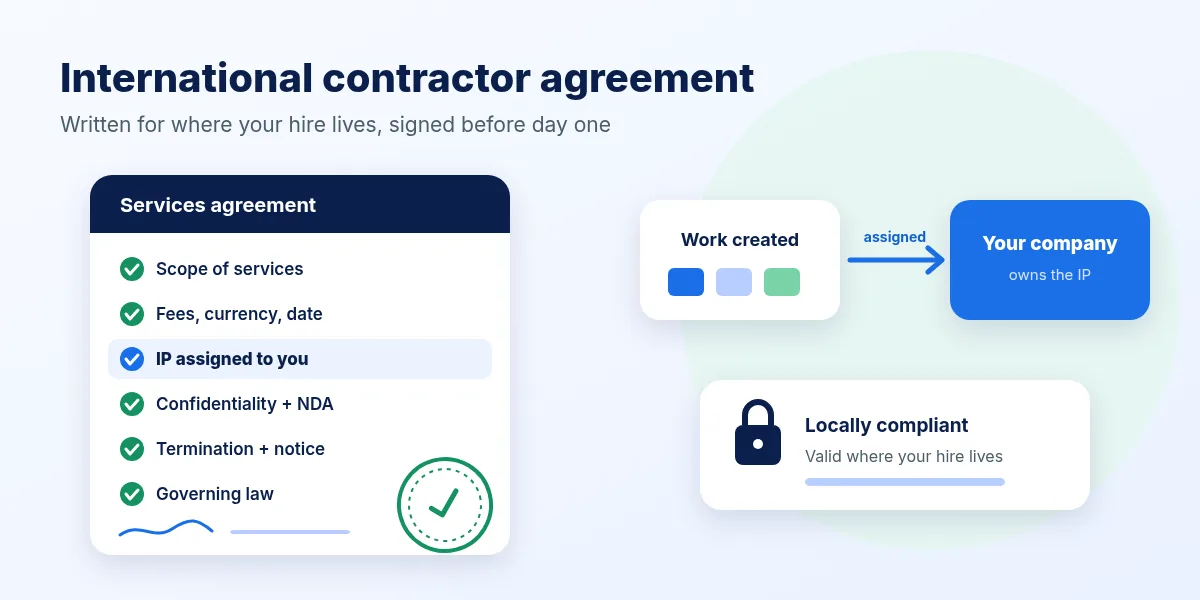
What is an international contractor agreement? It's the written contract between your company and an independent contractor who lives and works in another country. It sets out what they'll do, how and when they're paid, who owns the work, how confidential information is protected, how either side can end the arrangement and which law applies. To hold up, it has to match how you actually work together and be valid in the contractor's country, not just yours.
At minimum, include: the parties and contractor status, scope of services, term, fees and currency, hours and availability, equipment and security, IP assignment, moral rights and prior IP, confidentiality, data protection, non-solicitation, taxes and forms, termination, and governing law and language.
Last updated: October 18, 2026 · By the Talentige recruitment team · General information, not legal advice
Contractor agreement, EOR contract or your own entity: which document do you need?
Before you draft anything, decide how the person will be engaged. That one choice decides which contract you sign, who runs payroll and what the agreement has to cover.
| Contractor agreement | Employment contract through an EOR | Employment contract through your own local company | |
|---|---|---|---|
| Legal relationship | Services contract between your company and the contractor | The employer of record employs the person in their country | Your local company employs the person |
| Local payroll and statutory benefits | The contractor handles their own taxes | Run by the EOR, for a monthly fee | Run by you |
| What you need first | A locally compliant agreement | An EOR provider and its contract | A registered company in that country |
| Usual fit | One or a few full-time hires abroad | Formal local employment without your own entity | A large team in one country |
Most US companies hiring one or a few full-time people abroad use a contractor arrangement, and that's the document this guide covers. If you need the person formally employed in their country, the employment side is covered in our guide to international employment contracts, and our EOR vs staffing agency vs Upwork comparison sets out the published fees.
Before you draft: is this person really a contractor?
Writing "independent contractor" at the top of a contract doesn't make someone one. Tax authorities and courts look at how the relationship works in practice. Two examples show the pattern.
United States: the IRS common-law rules
The IRS groups the evidence into three categories: behavioral (does the company control, or have the right to control, what the worker does and how?), financial (how the worker is paid, whether expenses are reimbursed, who provides tools) and type of relationship (written contracts, employee-type benefits, permanence, and whether the work is a key part of the business). No single factor decides it; the IRS says to look at the entire relationship and document the factors you relied on.
Working remotely doesn't change the analysis. The IRS says a remote worker is an employee under the common-law rules if you can control what will be done and how it will be done.
Philippines: the four-fold test
Philippine courts generally apply four elements: (1) selection and engagement, (2) payment of wages, (3) the power of dismissal and (4) the power to control the means and methods of the work. The Supreme Court calls control the most determinative of the four.
In Royale Homes v. Alcantara (2014) the Court held that the label the parties put in their contract "cannot be conclusive", though it can't be brushed aside either, and that rules which guide the result without dictating the means and methods don't by themselves create employment.
Swipe to see the full chart, or open the table below.
See this chart as a table
| Factor | IRS common-law rules (US) | Four-fold test (Philippines) |
|---|---|---|
| Control over how the work is done | Yes (behavioral) | Yes (control, the most determinative) |
| How the worker is paid | Yes (financial) | Yes (payment of wages) |
| Who provides tools; expense reimbursement | Yes (financial) | Not a named element |
| Benefits and written contracts | Yes (type of relationship) | Not a named element |
| Permanence; work is a key part of the business | Yes (type of relationship) | Not a named element |
| Who selected and engaged the worker | Not a named category | Yes (selection and engagement) |
| Who can dismiss the worker | Not a named category | Yes (power of dismissal) |
Other countries use their own tests, and for someone who lives abroad the rules of their country are usually where a dispute would be heard. The practical lessons are the same everywhere:
- Make the documents match reality. Full-time hours, working only for you and using your tools are common in international contractor relationships, but write the arrangement down honestly rather than dressing it up.
- Manage outcomes, describe outcomes. Scope written as responsibilities and deliverables is clearer for both sides than a list of step-by-step instructions.
- Get local review. A contract that's valid where the person lives is the foundation. Every Talentige placement is on a government-stamped, locally compliant contract.
- Use the right tool when you need employment. If you need the person formally employed, with local payroll and benefits, use an employer of record. Don't stretch a contractor agreement to cover it.
The 14 clauses, one by one
Here's the full map, then each clause with what to write and what to watch for.
- 1Parties and status
- 2Scope of services
- 3Term and start date
- 4Fees, currency, payment
- 5Hours and availability
- 6Equipment and security
- 7IP assignment
- 8Moral rights and prior IP
- 9Confidentiality
- 10Data protection
- 11Non-solicitation
- 12Taxes and forms
- 13Termination and notice
- 14Law, disputes, language
Parties and contractor status
Write
Full legal names and addresses of both parties, the contractor's local tax ID if their country uses one on invoices, and a clear statement that this is an independent services relationship.
Watch for
The status clause helps show what both sides intended, but it won't override how the relationship works in practice. Pair it with the rest of the agreement and a real working arrangement that matches it.
Scope of services and deliverables
Write
The responsibilities and outcomes the person owns, the main deliverables, the systems they'll work in and how scope changes are agreed (in writing, with any change to fees).
Watch for
"General support as needed" invites disputes about what was agreed. Write the role the way you'd write a scorecard: five to seven outcomes, not a job title.
Term and start date
Write
The start date, whether the agreement is ongoing or for a fixed term, and any review point, for example a check-in after the first 90 days.
Watch for
A chain of short fixed terms renewed again and again. Ask local counsel how repeated renewals are treated in the contractor's country before you rely on them.
Fees, currency and payment
Write
The monthly fee, the currency, the payment date, the method, who pays transfer fees, how invoices are submitted and approved, and how pay changes are confirmed (always in writing).
Watch for
Fees that quietly come out of the contractor's pay, and raises agreed on a call but never written down. Our guide to how to pay international employees covers methods, currency and schedules.
Hours and availability
Write
The hours the person will be available, written in both time zones, expected response times, and how holidays work. Through Talentige, hires follow your holiday calendar, apart from maybe one or two local holidays agreed upfront.
Watch for
Clock changes. If either country moves its clocks, "9am" can shift by an hour twice a year. Our nearshore vs offshore guide shows the overlap by country.
Equipment, tools and security
Write
Who provides the computer and software licences, how accounts are created and removed, minimum security (multi-factor login, a password manager, an up-to-date device) and that all access and company data are returned at the end.
Watch for
Who provides tools is one of the factors in the IRS financial category. Whatever you decide, write it down so the agreement reflects the real setup.
Intellectual property assignment
Write
A present-tense assignment ("hereby assigns") of all work product created for you, effective on creation, worldwide, including source files, plus a promise to sign any further documents needed to record your ownership.
Watch for
Relying on "work made for hire" wording alone. For work by someone who isn't your employee, US law limits it to nine categories of commissioned work. More on this below.
Moral rights and pre-existing IP
Write
A waiver of, or consent not to assert, moral rights to the extent local law allows, and a short list of tools or templates the contractor already owns, with a licence to you for anything built into your deliverables.
Watch for
Moral rights (the right to be named as author and to object to harmful changes) are recognised in the Berne Convention and handled differently country by country, so this clause needs local wording.
Confidentiality and NDA
Write
A broad definition of confidential information (customer data, pricing, processes, source code, anything marked or obviously confidential), obligations that continue after the agreement ends, and return or deletion of materials. Every Talentige placement includes a signed NDA.
Watch for
NDAs that only protect "trade secrets". Customer lists and pricing are what most small businesses actually need to protect.
Data protection
Write
What personal data the person may access, that they follow your instructions and security rules, and that they return or delete it at the end. If you handle data about people in the EU, GDPR Article 28 sets out terms a contract with a processor must contain, such as documented instructions, confidentiality and deletion or return of data.
Watch for
Customer data copied to personal devices or personal email. Ask counsel which data-protection terms apply to your setup.
Non-solicitation
Write
That the contractor won't solicit your employees, contractors or clients for a defined period after the agreement ends.
Watch for
Broad non-compete clauses. How they're treated varies a lot between countries, so check with local counsel before you rely on one. Confidentiality and non-solicitation usually do the real work.
Taxes and forms
Write
That the contractor is responsible for their own taxes and registrations in their country. If they aren't a US person, collect a Form W-8BEN before the first payment and keep it in your records; the IRS says not to send Forms W-8 to the IRS.
Watch for
Issuing a 1099 by habit. US citizens and residents abroad are different: collect a W-9. Confirm your setup with your US accountant.
Termination and notice
Write
The notice period for each side, immediate termination for serious breach, the final invoice, a handover of work in progress, return of equipment and data, and which clauses survive (IP, confidentiality, non-solicitation).
Watch for
No handover clause. Without one, files, logins and half-finished work can leave with the person.
Governing law, disputes and language
Write
Which law governs and how disputes are resolved, with the contract referencing local law in the contractor's country. If the contractor's first language isn't English, consider a bilingual version so both sides understand the same terms.
Watch for
A contract drafted only under US law, with no reference to local law, gives weak protection in a dispute heard in the worker's home country.
IP assignment deserves its own section
For developers, designers, video editors and marketers, the work product is the point of the hire. Three facts explain why the IP clause needs care.
- "Work made for hire" is narrow for non-employees. Under the US Copyright Act, a work by someone who isn't your employee is only a work made for hire if it's specially ordered or commissioned in one of nine categories (such as a contribution to a collective work, part of an audiovisual work, a translation or a test) and both parties sign a written agreement saying so. A lot of everyday work, such as code, a logo or sales copy, doesn't fit neatly into those categories.
- A transfer has to be in writing. US law says a transfer of copyright ownership isn't valid unless it's in a written instrument signed by the owner of the rights. That's why the assignment belongs in the signed agreement, not in an email.
- Moral rights travel with the author. The Berne Convention recognises the author's right to claim authorship and to object to changes that would harm their honour or reputation. Countries handle these rights differently, so a local-law waiver or consent clause matters for creative work.
Every Talentige placement comes with a contract that assigns IP created for you to your company, alongside a signed NDA. That's particularly important for remote developers working in your repositories, video editors producing your content and teams at marketing agencies delivering client work.
Why a generic template is risky abroad
Templates are a reasonable starting point. These are the six gaps we see most often when a US template is used for someone in another country:
No reference to the contractor's local law, which is where a dispute is likely to be heard.
No present-tense assignment, so ownership of everyday work can be unclear.
No local registration, stamping or review where the contractor's country offers it.
Hours written only in US time, with no plan for clock changes.
No currency, payment date or rule on who pays transfer fees.
The contract describes a relationship that doesn't match how you actually work together.
From offer to day one: the signing timeline
- Step 1Offer acceptedPay, currency, hours and start date agreed in writing.
- Step 2Agreement draftedScope, fees, IP assignment, confidentiality, termination and governing law.
- Step 3Local review and registrationChecked against local law, and stamped or registered where the country allows it.
- Step 4NDA signedBefore any access to systems or customer data.
- Step 5Tax form and payment set upForm W-8BEN (or W-9) on file and a small test payment confirmed.
- Day oneStart workAccounts ready, first tasks written down and a named person for questions.
When you hire through Talentige, steps 2 to 4 are handled for you as part of the placement, before day one.
International contractor agreement checklist
Work through this before your contractor signs. If any box is empty, fix it first.
Before you draft
- Engagement model decided: contractor agreement or employment through an EOR
- Role scorecard written: outcomes, hours, tools, language
- Pay, currency and payment date agreed
- Hours confirmed in both time zones
In the agreement
- Parties, addresses and independent status
- Scope and how changes are agreed
- Term, start date and any review point
- Fees, currency, invoicing and transfer fees
- Equipment, accounts and security rules
- Present-tense IP assignment and further assurances
- Moral rights wording and a prior-IP list
- Confidentiality that survives the end
- Data-protection terms where needed
- Non-solicitation for a defined period
- Tax responsibility clause
- Notice, handover and surviving clauses
- Governing law, disputes and a bilingual version if useful
Before day one
- Local review done; stamped or registered where available
- NDA signed
- Form W-8BEN (or W-9) on file
- Test payment received
- Accounts and first-week plan ready
How this works when you hire through Talentige
Every Talentige placement is on a government-stamped, locally compliant contract with a signed NDA, and IP created for you is assigned to your company. There's no separate contract fee: the contract, NDA and government stamping are part of the placement. You choose between two ways to work with us:
One-time placement
A one-time fee based on annual salary. Pay only when you hire. 90-day free replacement. Best for building your own team.
Month-to-Month
From $2,000/mo, all-inclusive, with no placement or setup fees. Includes international payroll and contracts. Cancel anytime, with free replacement throughout.
See both options on our pricing page and the full process on how it works. Typical full-time monthly pay through Talentige runs $1,200–$1,700 for sales reps, $1,200–$1,600 for admins, $1,500–$2,300 for managers, $1,400–$2,900 for developers and $1,000–$1,300 for video editors. Model your own roles in the overseas hiring cost calculator.
Confidentiality matters most in some industries. See how it works for law firms and accounting firms, or start from a country: Mexico, Latin America, Morocco or the Philippines. UK business? See offshore staff for UK firms. For the overall approach, read how to hire overseas employees.
Skip the contract work. Hire with it done.
Tell us the role, hours and budget. We'll find and vet your hire, and handle the government-stamped contract, NDA and IP assignment before day one.
Book a free hiring call →Pay nothing until you hire · 3–5 vetted finalists · 90-day replacement guarantee
Frequently asked questions
What is an international contractor agreement?
What should an international contractor agreement include?
Who owns the work an international contractor creates?
Can I use a US contractor template for someone abroad?
Does calling someone a contractor in the contract make them one?
Which country's law should govern an international contractor agreement?
Do I need a Form W-8BEN from an international contractor?
Does Talentige provide the contractor agreement?
Disclaimer: This guide is general information for business owners, not legal or tax advice. Laws differ by country and change; have your agreement reviewed for the contractor's country.
Sources
- Internal Revenue Service, "Independent contractor (self-employed) or employee?" (common-law rules: behavioral, financial, type of relationship; remote workers), last reviewed May 19, 2026. irs.gov
- Supreme Court of the Philippines, Royale Homes Marketing Corporation v. Fidel P. Alcantara, G.R. No. 195190, July 28, 2014 (four-fold test; control test; contract label not conclusive). lawphil.net
- U.S. Copyright Office, Circular 30, "Works Made for Hire" (definition in 17 U.S.C. § 101 and the nine categories). copyright.gov
- 17 U.S.C. § 204(a), Execution of transfers of copyright ownership. copyright.gov
- World Intellectual Property Organization, Summary of the Berne Convention for the Protection of Literary and Artistic Works (moral rights). wipo.int
- Regulation (EU) 2016/679 (GDPR), Article 28, Processor. gdpr-info.eu
- Internal Revenue Service, Instructions for the Requester of Forms W-8BEN, W-8BEN-E, W-8ECI, W-8EXP and W-8IMY ("Do not send Forms W-8 to the IRS"), and About Form W-8BEN. irs.gov
- Talentige placement data and service terms (as of October 2026): 1,750+ hires since 2015; government-stamped, locally compliant contracts with a signed NDA and IP assigned to the client; typical monthly pay ranges by role; pricing options as published on talentige.com/pricing.