Hire Remote Workers in Mexico, on Your Time Zone
Bilingual support reps, SDRs, assistants, bookkeepers and developers from Mexico who work your hours, only for your team. Talentige runs the search, the tests, the background checks, the contract and the payments. You pick from 3–5 finalists.
A US 9-to-5, in Mexico City time (Nov–Mar)
Can a US company hire full-time remote workers in Mexico without a Mexican entity? Yes. Talentige finds, tests and shortlists bilingual professionals in Mexico, you interview 3–5 finalists, usually within about 14 days, and your hire joins your team full-time as a contractor. They work only for you, on your schedule, in your tools. We handle the background check, contract, international payment and Hubstaff time tracking, so there's no Mexican payroll or company to set up.
Talentige has made 500+ hires across Latin America. Mexico is the easiest place in the world for a US team to add people: same working day, Spanish for your Hispanic customers, and a 62.6-million-strong labour force next door.
Last updated: October 10, 2026 · By the Talentige recruitment team, recruiting international talent since 2015
Mexico vs US time zones: how the workday lines up
Here's what a US 9-to-5 looks like in Mexico City. In practice it doesn't matter much, because your hire works the hours you set, but it shows why Mexico needs no night shifts at all.
| Your team works 9 a.m.–5 p.m. in… | Mexico City time, Nov–Mar (US standard time) | Mexico City time, Mar–Nov (US daylight time) |
|---|---|---|
| US Eastern (New York, Miami) | 8 a.m.–4 p.m. | 7 a.m.–3 p.m. |
| US Central (Chicago, Dallas) | 9 a.m.–5 p.m. | 8 a.m.–4 p.m. |
| US Pacific (Los Angeles, Seattle) | 11 a.m.–7 p.m. | 10 a.m.–6 p.m. |
Most of Mexico is on UTC−6 year-round. Quintana Roo (Cancún) uses UTC−5, and some municipalities on the US border follow US daylight saving time.
Why US companies hire in Mexico
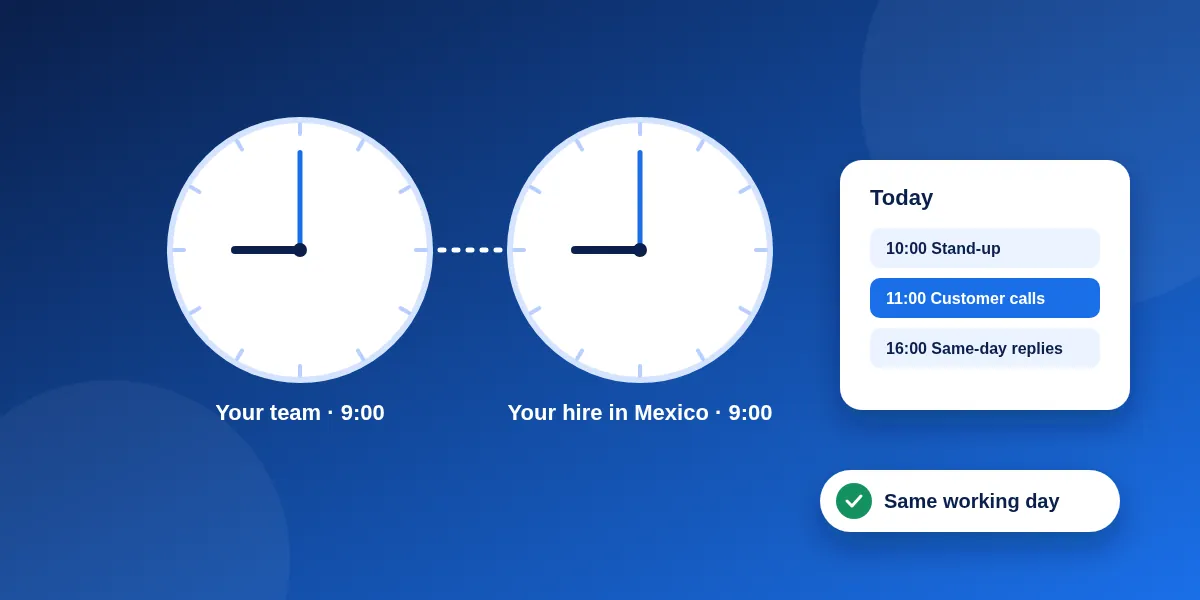
Most offshore hiring asks you to bend your day around the other side of the world. Mexico doesn't. Your new teammate starts when your team starts, joins the 10 a.m. stand-up live, and picks up the phone when a customer in Texas or Illinois calls at 4 p.m. That alone changes what you can hand over: live sales calls, same-day customer replies, real-time dispatch and fast back-and-forth with your managers.
One working day, not two
Since Mexico ended daylight saving time in 2022, Mexico City, Guadalajara and Monterrey stay on UTC−6 all year. That's US Central time in winter and one hour behind Central in summer. No night shifts, no hand-off lag.
Spanish for 44.9 million US Spanish speakers
That's how many people in the US spoke Spanish at home in 2024 (US Census Bureau). A Mexican hire talks to them in their first language, then writes your internal updates in English.
A huge, working talent pool
Mexico's economically active population reached 62.6 million people in August 2026 (INEGI). Inside it is a deep bench of people who already serve US customers every day in support, sales, logistics and software.
English where it counts
In the EF EPI 2025, Mexican customer service professionals score 599 and IT professionals 559, well above the 488 global average, and Monterrey scores 532. Those are the people we recruit, and our tests prove it before you meet them.
Where we find talent in Mexico
See this chart as a table
| City | EF EPI 2025 English score |
|---|---|
| Monterrey | 532 |
| Culiacán | 524 |
| Morelia | 518 |
| Hermosillo | 513 |
| Guadalajara | 511 |
| Global average | 488 |
We search nationally, but a few metro areas consistently produce the strongest bilingual candidates:
- Monterrey (Nuevo León). The top-scoring city in Mexico for English in the EF EPI 2025 (532), and Nuevo León is the top-scoring state (519). A business and industrial centre with a strong university system and lots of experience working with US companies.
- Guadalajara (Jalisco). Scores 511 in the EF EPI 2025 and is one of Mexico's best-known technology hubs, a strong source of developers, QA testers and tech support.
- Mexico City. The country's largest metro area and its centre for finance, media and corporate services, so it has the biggest pool of experienced sales, marketing, finance and admin profiles.
- Hermosillo, Culiacán, Morelia, Querétaro and beyond. Hermosillo (513), Culiacán (524) and Morelia (518) all score above the 488 global average for English, and remote work means we can hire the best person wherever they live.
Want to see what a Mexico shortlist looks like for your role?
Tell us the role, the hours and the languages. We'll tell you where we'd search and what the role typically pays.
Book a free hiring call →What Mexican professionals do best, by role
We've seen Mexico shine wherever being live with US customers matters. These are the roles we'd point you to first:
Bilingual customer support
Phone, chat and email support in English and Spanish, on your hours. Mexican customer service professionals score 599 for English in the EF EPI 2025, and they understand US customers.
SDRs and appointment setters
Calling during your prospects' business day is easy from Mexico. Every rep does a live sales role play before you meet them. See how we recruit remote SDRs.
Operations, dispatch and logistics
Scheduling, order management, carrier calls and dispatch for US field teams, with same-day answers because your hire is on shift when your trucks and techs are.
Executive assistants and admin
Inbox, calendar, CRM and document work in real time. Admin candidates complete real admin tasks during screening, not just an interview.
Bookkeepers and finance assistants
AP, AR, reconciliations and month-end support in QuickBooks, Xero or your own system, during your finance team's hours.
Mexican developers, QA and IT support
Guadalajara and Monterrey have grown into major technology hubs. Developers pass technical tests with us, then work your sprint hours and join code reviews live.
And every other role. These are just where Mexico shines. Across Latin America we've made 500+ hires: sales reps, SDRs, admin assistants, executive assistants, bookkeepers, dispatchers, video editors, managers, AI specialists and much more. If the work can be done remotely, we can recruit it in Mexico.
Hiring for a specific role? See how we recruit developers, customer support reps, virtual assistants, executive assistants, bookkeepers, video editors, dispatchers and SDRs.
Cost of hiring in Mexico vs the US
Here's the gap for the roles companies most often hire in Mexico. The left side is what a full-time professional typically earns through Talentige. The right side is the US median salary for the closest matching job, before and after employer benefits and payroll taxes.
| Role (full-time) | Typical Latin America range (monthly, USD) | Per year | Same role in the US (BLS median, per year) | Yearly pay difference per hire* |
|---|---|---|---|---|
| Bilingual customer support | $900–$1,500 | $10,800–$18,000 | About $44,800 About $64,000 with overhead | At least $46,000 |
| SDR / appointment setter | $1,200–$2,000 | $14,400–$24,000 | About $70,000 About $100,100 with overhead | At least $76,100 |
| Executive assistant | $1,000–$1,800 | $12,000–$21,600 | About $76,600 About $109,500 with overhead | At least $87,900 |
| Bookkeeper / finance assistant | $1,000–$1,600 | $12,000–$19,200 | About $50,700 About $72,500 with overhead | At least $53,300 |
| IT support specialist | $1,100–$1,600 | $13,200–$19,200 | About $61,900 About $88,500 with overhead | At least $69,300 |
| Developer (mid to senior) | $2,000+ | from $24,000 | About $136,000 About $194,500 with overhead | About $164,500 |
*US figures: national median hourly wage for the closest matching occupation (BLS OEWS, May 2025; junior developer uses the 25th-percentile wage as an early-career benchmark) × 2,080 hours, rounded to the nearest $100. "With overhead" multiplies by 1.43, because US private-industry employers spent $46.89 per hour on total compensation against $32.82 in wages in June 2026 (BLS ECEC). The difference compares the US cost with overhead against the top of the typical Latin America range; for developers, which have no fixed upper end, we compare against a $2,500 a month hire. Latin America figures are typical Latin America ranges from Talentige placements across the region, not country-specific quotes; we confirm the range for your exact role on the call. Our one-time placement fee depends on the role and is separate.
Try other roles and team sizes in the overseas hiring cost calculator, or read the full math in our international hiring cost breakdown.
Your calendar, your currency
Your holiday calendar
Mexican hires follow your company's holiday calendar, apart from maybe one or two local holidays you agree upfront. No second calendar to plan around.
Paid in your currency
Talentige handles payment, and your hire is paid in your currency: USD for US clients, CAD for Canadian clients, EUR for European clients, AUD for Australian clients and GBP for UK clients. No foreign transfers or currency conversion on your side.
Hiring elsewhere in the region? See our guides to hiring in Colombia, Argentina and Brazil, or the full Latin America hiring guide.
Talentige vs outsourcing firms, freelancers and EORs in Mexico
There are three common ways to get work done in Mexico. Here's how they compare with hiring through us.
| Outsourcing / call centre | Freelance platform | Employer of record (EOR) | Talentige | |
|---|---|---|---|---|
| Who finds the person? | The vendor assigns staff | You sift through profiles | You do; the EOR only employs them | We source, test and shortlist 3–5 finalists |
| Dedicated to you? | Often shared across clients | Usually juggling several clients | Yes | Yes, full-time and never shared |
| Who manages the work? | The vendor's supervisors | You, with little visibility | You | You, with Hubstaff time tracking and our support |
| How you pay | Ongoing per-seat or hourly markup | Platform fees on every payment | Monthly fee per worker on top of salary | One-time fixed placement fee, with no retainer by default (a small optional retainer applies only if you want us to manage payment and admin monthly) |
| If it doesn't work out | Vendor rotates staff | Start again | Start again, plus offboarding | 90-day replacement guarantee |
If you want a teammate rather than a seat in someone else's call centre, that's what we do. Comparing providers? Use our checklist of questions to ask a global staffing agency.
How we test Mexican candidates before you meet them
English, written and oral, plus Spanish on request
A formal English test in writing and in conversation for every candidate, and a formal Spanish test too for any client who wants one.
Communication assessments
How clearly they explain, follow up and handle a difficult conversation.
Role-specific tests
Sales role plays for reps, real admin tasks for assistants and technical tests for developers. For certain roles, candidates also complete AI training.
Background checks
We run a background check on the finalist you choose before they start.
How to hire in Mexico with Talentige
- Free hiring call. Role, hours, languages, must-have skills and budget.
- Search and testing. We approach candidates across Mexico and run the full set of assessments.
- Your shortlist. 3–5 vetted finalists with notes on each, usually within about 14 days.
- You choose. Interview the finalists and pick your hire.
- We set everything up. Background check, contractor agreement, international payment, Hubstaff and onboarding.
- Then we build your team. Most clients add more roles once the first hire is up and running, and we stay involved with support and the 90-day guarantee.
Hiring in other countries too? See all our Latin America recruiting, and for French-English roles, our Morocco team.
By industry: Spanish-English hires here staff law firm intake and truck dispatch, including cross-border freight. Bilingual front desks too: dental practices and medical practices.
Hiring in more than one market? See every role and region we recruit in and how our process works. Need a French-, Spanish- or Arabic-speaking agent? See bilingual customer support.
Hiring for sales? See our guide to bilingual SDRs from Mexico, on US calling hours.
Frequently asked questions about hiring in Mexico
Is it a good idea to hire remote workers in Mexico?
What time zone is Mexico in compared with the US?
How good is English in Mexico?
How much does it cost to hire a remote worker in Mexico?
Can I hire Mexican developers through Talentige?
Is outsourcing to Mexico the same as hiring through Talentige?
Do I need a Mexican company or payroll?
Do Mexican hires follow our holidays, and what currency are they paid in?
What if the hire doesn't work out?
Meet your Mexico finalists in about 14 days
Tell us about the role and we'll come back with a plan, a realistic budget and 3–5 vetted finalists.
Book a free hiring call →Pay nothing until you hire · 3–5 vetted finalists · 90-day replacement guarantee
Sources
- INEGI, Encuesta Nacional de Ocupación y Empleo (ENOE), monthly results for August 2026: economically active population 62.6 million. inegi.org.mx
- EF Education First, EF English Proficiency Index 2025, Mexico fact sheet: job-function scores (customer service 599, IT 559); global average 488; Nuevo León 519; Monterrey 532, Culiacán 524, Morelia 518, Hermosillo 513, Guadalajara 511. ef.com
- Time zones: Mexico's Ley de los Sistemas Horarios (Diario Oficial de la Federación, October 28, 2022) ended seasonal daylight saving time for most of the country; current Mexico City offset UTC−6. timeanddate.com
- U.S. Census Bureau, American Community Survey 2024 (language spoken at home), as summarised by USAFacts. usafacts.org
- U.S. Bureau of Labor Statistics, Occupational Employment and Wages, May 2025 (national median hourly wages; software developers 25th percentile). bls.gov
- U.S. Bureau of Labor Statistics, Employer Costs for Employee Compensation – June 2026, private industry: total compensation $46.89/hour, wages $32.82/hour. bls.gov
- Talentige placement data: 500+ hires across Latin America; typical Latin America pay ranges, roles filled, holiday arrangements, payment currency and screening process based on Talentige placements (as of October 2026).