How to Pay International Employees and Contractors
Payment methods, currency, schedules, year-end pay and the US tax forms you need, from a recruiter that sets up payment for hires every month, whether we handle it or you pay directly.
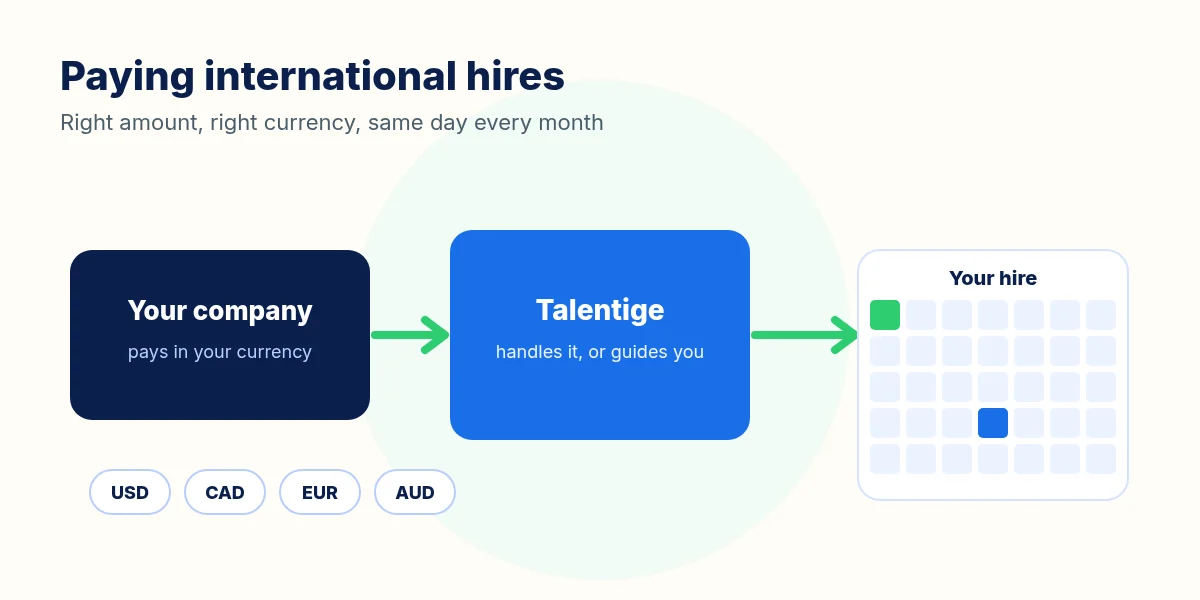
How do you pay international employees? First decide whether the person is an employee (through an employer of record or your own local company) or an independent contractor. Employees are paid through local payroll, with local taxes and benefits such as year-end pay. Contractors invoice you, and you pay them by bank wire, a money-transfer service, a contractor platform or through your recruitment partner. For a contractor who isn't a US person and works outside the US, collect a Form W-8BEN; in general no 1099 or US withholding applies. With Talentige you choose: we handle payment to your hire, or you pay your hire directly with our guidance on the best option for their country.
Last updated: October 12, 2026 · By the Talentige recruitment team
Employee or contractor? Decide this first
How you pay someone depends on how they're engaged. Everything else (method, currency, tax forms, year-end pay) follows from that one decision.
Employee (EOR or local entity)
Formally employed in their country.- Paid through local payroll
- Employer pays local social contributions and benefits
- Statutory extras apply, such as year-end pay
- Usually needs an employer of record (monthly fee) or your own local company
Independent contractor
Provides services to your company under a contract.- Invoices you, usually monthly
- Handles their own local taxes
- Terms (time off, bonuses, notice) are what the contract says
- No local entity needed. The contract must be locally compliant
Most US companies hiring one or a few full-time people abroad use a contractor arrangement. That's the model Talentige uses: every hire is on a government-stamped, locally compliant contract with a signed NDA, works full-time for one client only, and is paid in your currency, either through Talentige or by you directly with our guidance. If you need formal local employment, an employer of record is the right tool. Our EOR vs staffing agency vs Upwork guide compares the published fees.
Whichever you choose, don't mix them up. Someone you treat like an employee but pay like a contractor can create classification risk in both countries. Write the arrangement down and pay the way the contract says.
Payment methods compared
There are four practical ways to get money to an international hire each month:
− Sending and intermediary fees, exchange-rate margins, several days to arrive
− You run payroll yourself: dates, records and currency
− Monthly per-person fees for as long as the person works for you
− Only for hires made through Talentige
Cost differences between methods are bigger than most people expect. The World Bank tracks the price of sending money between countries every quarter. Its benchmark is a $200 transfer. Salaries are larger, so the exact percentages differ, but the ranking is the useful part: banks are consistently the most expensive way to send money abroad.
See this chart as a table
| Provider type | Average cost (% of $200 sent) |
|---|---|
| Banks | 14.99% |
| Global average, all providers | 6.36% |
| Money transfer operators | 4.72% |
| Digital-only services (SmaRT average) | 3.29% |
Two hidden costs to watch with bank wires: intermediary (correspondent) bank fees, which come out of the amount your hire receives, and the exchange-rate margin, which doesn't show up as a fee at all. If your hire receives less than you sent, that's where it went. Before you choose a provider, send a small test payment and ask your hire what actually arrived.
Which currency to pay in
You have two choices: fix the pay in your currency (for example USD) and let your hire convert it, or fix it in their local currency and absorb the exchange-rate movements yourself.
- Paying in your currency keeps your budget predictable. Your hire carries the exchange-rate risk. In many markets, pay pegged to USD or EUR is attractive to candidates for exactly that reason.
- Paying in local currency keeps your hire's income stable. You carry the risk, and your monthly cost moves with the exchange rate.
Whichever you choose, write it in the contract: the amount, the currency, and who pays transfer fees. With Talentige you pay in your own currency (USD for US clients, CAD for Canada, EUR for Europe, AUD for Australia, GBP for the UK), whichever payment option you choose. Pay ranges are published in USD on our overseas hiring cost calculator and the country pages for Latin America, Morocco, Egypt and the Philippines.
Set a pay schedule (and stick to it)
Monthly pay is the norm for full-time international contractors. What matters most is that the date never moves. A late payment costs more trust than almost anything else you can do to a remote hire, because they can't walk into your office and ask.
A simple schedule that works:
An example schedule. Pick dates that fit your accounting close and leave a few days for transfers.
- Close hours a few days before month-end so there's time to review and approve.
- Allow transfer time. Bank wires can take several business days. Send early, not on the due date.
- Watch local bank holidays around the payment date in your hire's country.
- Put the date in the contract so both sides can plan.
Holidays, time off and year-end pay
Decide upfront which holidays your hire takes. Through Talentige, your hire follows your holiday calendar, apart from maybe one or two local holidays you agree upfront. That keeps your team on one schedule.
Year-end pay is where employees and contractors differ most. Many countries require employers to pay a statutory year-end bonus to employees. If you employ someone through an employer of record in these countries, expect it in the cost:
| Country | Statutory year-end pay (employees) | Deadline | Law |
|---|---|---|---|
| Mexico | Aguinaldo: at least 15 days of salary, prorated for part-year service | Before December 20 | Ley Federal del Trabajo, Art. 87 |
| Philippines | 13th-month pay: one-twelfth of basic salary earned in the year | No later than December 24 | Presidential Decree No. 851 |
| Colombia | Prima de servicios: 30 days of salary per year, in two halves | By June 30 and by December 20 | Código Sustantivo del Trabajo, Art. 306 |
These rules apply to employees. Under a contractor agreement, pay, bonuses and time off are whatever the contract says, so agree them in writing from day one. Your hire will know local norms. Talk about them openly when you set pay, rather than in December.
US tax forms: W-8BEN, not a 1099
This is the most common mistake we see US companies make with international contractors. If your contractor is not a US person and does all the work outside the United States:
- Collect a Form W-8BEN (individual) or W-8BEN-E (company) before the first payment. Keep it on file. It isn't sent to the IRS.
- In general, no Form 1099-NEC is required for that payment, and no US withholding applies.
- Payments for services performed abroad are foreign-source income, so Form 1042-S reporting generally doesn't apply either.
Different rules apply if the person is a US citizen or green-card holder living abroad (collect a W-9 and expect a 1099-NEC), or if any of the work is done in the US. Check with your US accountant before your first payment. The tax and social-security obligations in your hire's own country are theirs under a contractor agreement, and the employer's under an EOR. Our guide to international employment contracts covers the contract side.
The true cost of paying someone abroad
When you compare options, look at the total over a year, not the monthly fee. The total has three parts:
Option A: Talentige handles payment
Small monthly retainer for payment and management.
Option B: you pay your hire directly
We recommend the best option for your hire's country. No monthly markup or retainer.
- The pay itself. For example, $1,400 a month for a full-time hire is $16,800 a year.
- Ongoing fees. Platform fees, EOR fees or an agency markup, every month, for as long as the person works for you. With Talentige there's no monthly markup or retainer if you pay your hire directly. If you'd rather we handle payment and management every month, there's a small retainer.
- One-time and transfer costs. With Talentige, a one-time fixed placement fee that depends on the role, and nothing until you hire. If you pay directly, add transfer fees and exchange-rate margins, which is why the provider you pick matters.
Our worked example for a $1,400-a-month hire shows how the same hire adds up over a year on a freelance marketplace, through an EOR and through Talentige.
Time tracking and records
Good records protect both sides and make every payment easy to check. Keep, for every hire:
- The signed contract and NDA, and any later changes to pay.
- Form W-8BEN (or W-9 for a US person).
- Monthly invoices or pay statements, and proof of each payment.
- Time records, if pay or performance reviews depend on hours.
Through Talentige, time is tracked in Hubstaff, so you can see hours worked without asking. Keep these records for as long as your accountant advises.
Five payment mistakes to avoid
- Paying late, even once. Your hire can't walk over to your desk and ask what happened. Automate the payment or put two reminders in your calendar, and tell your hire straight away if anything will be late.
- Letting fees come out of their pay. If you agree on $1,400 a month and $1,360 arrives, your hire has had a pay cut you didn't intend. Agree who pays transfer fees, and check what actually arrives.
- Issuing a 1099 by habit. Your accounting system may default to 1099s for every contractor. For a foreign contractor working abroad, collect a W-8BEN instead and make sure your system knows the difference.
- Changing pay informally. A raise agreed on a call and never written down causes confusion at the next payment. Update the contract or send a written confirmation for every change.
- Treating a contractor like an employee on paper. Fixed hours, company equipment and managed time off can all be fine, but your documents should match the real arrangement. If you need formal employment, use an employer of record. Don't stretch a contractor agreement.
None of these are expensive to fix, but each one costs trust. The goal is a payment your hire never has to think about: the right amount, in the right currency, on the same day every month.
First-payment checklist
- Engagement decided: contractor on a locally compliant contract, or employee through an EOR.
- Pay amount, currency and payment date written in the contract.
- Form W-8BEN (or W-9) collected and filed.
- Payment method chosen and a small test payment confirmed.
- Holiday calendar agreed, including any local holidays.
- Time tracking set up and the monthly approval date in your calendar.
- Year-end pay and bonuses agreed in writing.
Still choosing who to hire? Start with how to hire international employees, or see our role guides for virtual assistants, customer support, bookkeepers and SDRs.
Pay your hire your way
Hire through Talentige and choose: we handle payment and management for a small monthly retainer, or you pay your hire directly with our guidance on the best option for their country. Either way, a government-stamped contract and NDA are in place.
Book a free hiring call →Pay nothing until you hire · 3–5 vetted finalists · 90-day replacement guarantee
UK business? See offshore staff for UK businesses, paid in GBP or USD.
Frequently asked questions
What is the best way to pay international employees?
Can I pay international employees in US dollars?
Do I need to issue a 1099 to a foreign contractor?
Do I have to pay a 13th-month salary?
How often should I pay an international contractor?
How much does it cost to send money abroad?
Who pays my hire if I hire through Talentige?
Which holidays does my international hire take?
Sources
- World Bank, Remittance Prices Worldwide, Issue 54 (Q3 2025 data): global average cost 6.36%; banks 14.99%; money transfer operators 4.72%; SmaRT average 3.29%. remittanceprices.worldbank.org
- Mexico, Ley Federal del Trabajo, Article 87 (aguinaldo), and Secretaría del Trabajo y Previsión Social guidance. stps.gob.mx
- Philippines, Presidential Decree No. 851 (13th-month pay) and implementing rules. library.laborlaw.ph
- Colombia, Código Sustantivo del Trabajo, Article 306 (prima de servicios). leyes.co
- Internal Revenue Service, Instructions for the Requester of Forms W-8BEN, W-8BEN-E, W-8ECI, W-8EXP and W-8IMY. irs.gov
- 26 CFR § 1.6041-4, Foreign-related items and other exceptions (no information return for payments to a foreign person documented on Form W-8). ecfr.gov
- Talentige placement data (as of October 2026): 1,750+ hires in total, including 500+ in Morocco, 250+ in Egypt, 500+ in the Philippines and 500+ across Latin America; typical monthly pay ranges, timelines, screening process, holiday arrangements and payment currency are based on Talentige placements.